Work management for condition monitoring.

Datum carries every escalation from the analyst's initial call through verification, approval, planning, execution and sign-off, and closes it only when a follow-up measurement confirms the repair held. Your CMMS still executes the work. Datum holds the condition evidence, the decisions and the proof.

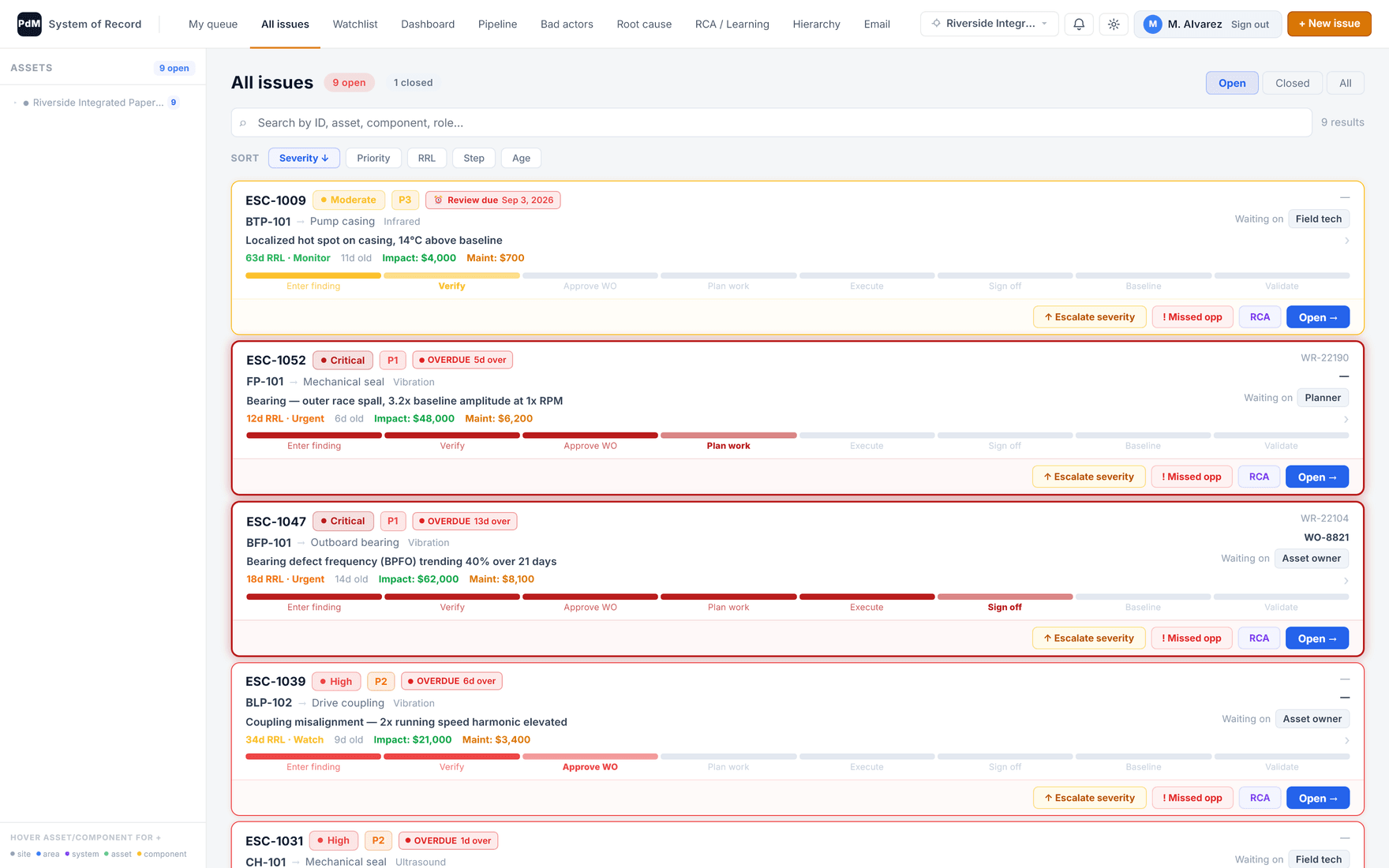
The Datum escalation queue: cards sorted by severity, each showing priority, remaining reliable life, production impact and maintenance cost, the stage it currently occupies, and an eight-stage progress strip.
Fig. 01The escalation queue, ordered by consequence rather than arrival. Each card shows the stage it currently occupies.

Screenshots throughout show Datum's demonstration facility, an integrated paper mill.

Detection is rarely the problem. What follows it is.

A capable analyst identifies a developing fault and issues a report. It reaches the site as an attachment. From there the escalation depends on recollection: someone has to read it, judge it, raise the work, schedule it, and afterwards confirm the condition actually improved.

Each of those hand-offs happens outside any system that records them, and any one of them can quietly end the matter. Programs seldom fail because the analysis was wrong. They fail because a sound call was made and nothing durable was built around it.

The report goes out, and nothing comes back.

An escalation moves through eight defined stages and always occupies a known one. What was raised, what was decided and what remains outstanding is visible without anyone being asked.

The work order was closed. Whether the fault is gone is a separate question.

Datum will not close an escalation without a follow-up measurement taken against the baseline. Completion and correction are recorded as the different claims they are.

Everything is urgent, so work happens in the order it arrived.

Order is set by the asset's criticality rating, the severity of the escalation and its remaining reliable life — not by who raised the matter most recently.

“We’ll pick it up at the next outage,” and then nobody does.

A deferral carries a review date and returns to the queue when that date arrives. A hold left open indefinitely ages and is flagged rather than forgotten.

The same machine keeps failing and no one has joined the incidents up.

Repeat offenders are assembled from the escalation history itself, so the pattern is visible from the record rather than from whoever happens to remember it.

The one that was missed is never examined.

Faults that were detectable and not caught are logged against the program by category — detection, interpretation, coverage or process — with the reactive cost they carried.

Eight stages, and an escalation always occupies one of them.

An escalation enters as the analyst's determination and leaves as a verified repair. Every stage is defined, and the record shows which one an escalation currently sits at and how long it has been there. Nothing rests in an undefined state.

  1. 1Enter findingAnalyst
  2. 2VerifyField tech
  3. 3Approve WOAsset owner
  4. 4Plan workPlanner
  5. 5ExecuteMaintenance crew
  6. 6Sign offAsset owner
  7. 7BaselineField tech
  8. ValidateAnalyst

Validation is the stage most programs omit. It is a follow-up measurement taken against the baseline after the work is done, and Datum will not close an escalation without one.

The distinction it preserves is not a small one. The work order was completed and the condition was corrected are different claims, and only the second is worth recording.

See the eight stages running on your own equipment.

Request a demo

Datum does not replace your CMMS.

Your CMMS plans labor, reserves parts and records completion, and it should go on doing so. What it was never designed to hold is the reasoning behind the request: the spectra, the severity judgment, the remaining life estimate, and the measurement that afterwards confirms the fault is gone.

Datum holds that material and references the work order by number, so the two records stay joined without either system pretending to be the other.

Your analysts work wherever they are.

Whether an analyst sits in the building or reviews your routes from three states away, escalations are entered into the same record the site works from. The site can see the reasoning behind a call; the analyst can see what became of it. Neither has to ask.

Inside the record

Five views from the demonstration facility.

An escalation is a record, not a ticket.

ESC-1052 is a critical vibration escalation on a fiber-prep pump, presently at the planning stage. The original call, the field verification and the approved impact figure remain attached as the work proceeds. Nothing is retyped, and nothing is carried between systems by hand.
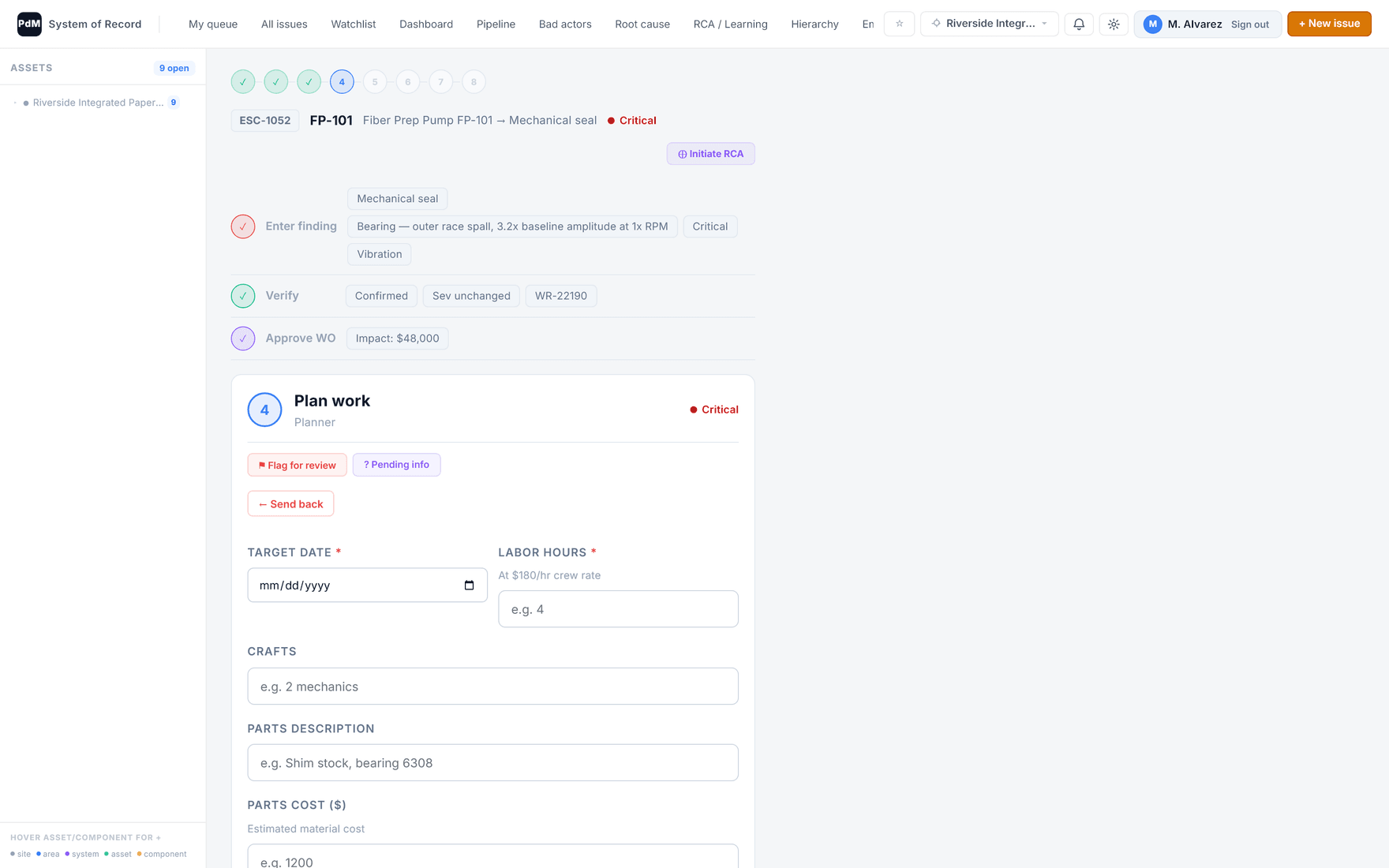
An open escalation at stage four of eight, with the first three stages marked complete and their recorded values shown above the planning form.
Fig. 02ESC-1052 at the planning stage. Completed stages keep their evidence in view.

Root cause analysis, kept with the escalations it came from.

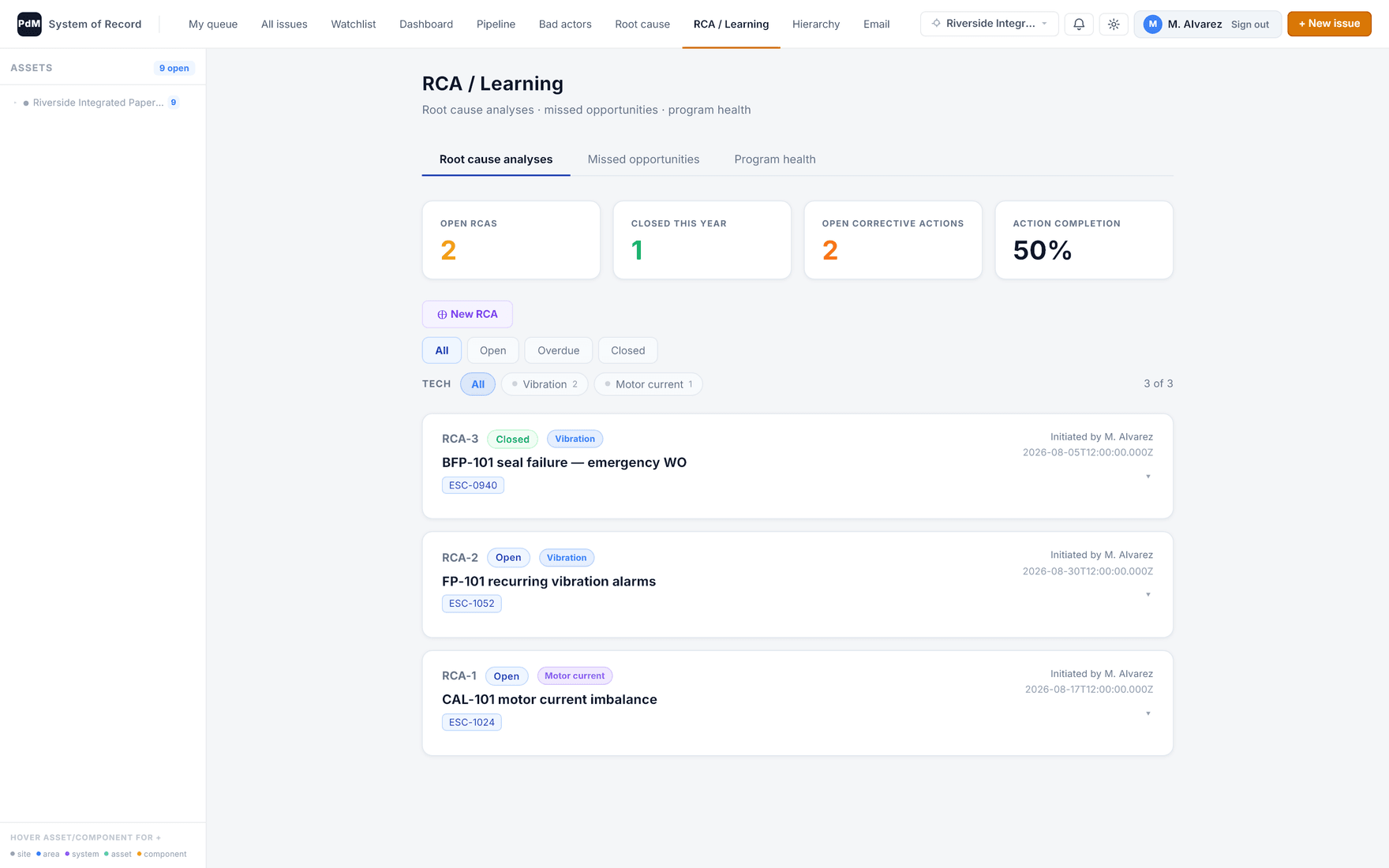
Five whys, physical and latent causes, corrective actions and attached evidence, each linked to the escalations that prompted the investigation. The analysis stays where the condition history is rather than in a document nobody opens twice.

The RCA and learning view: counts of open and closed analyses and corrective-action completion, above a list of root cause analyses each linked to its escalation.
Fig. 03Root cause analyses, with corrective-action completion tracked alongside.

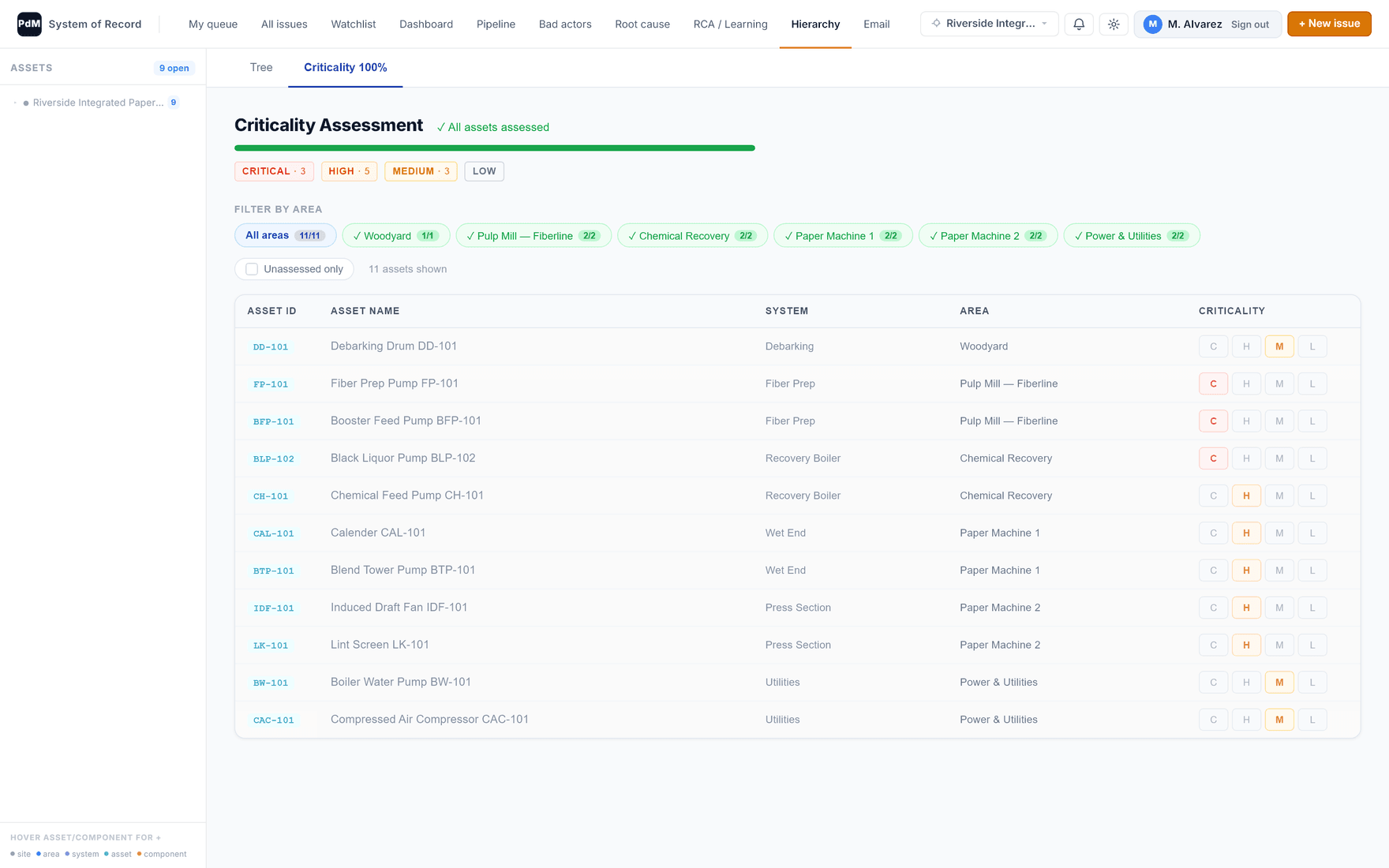
Asset criticality sets the order, not arrival time.

Each asset carries a criticality rating, assessed once against the site hierarchy and applied thereafter. Combined with the severity of the individual escalation and its remaining reliable life, it determines where that escalation sits in the queue, so a critical machine is never waiting behind a spare.

The criticality assessment table: each asset listed with its system and area and a critical, high, medium or low rating.
Fig. 04Asset criticality assessed across the site hierarchy.

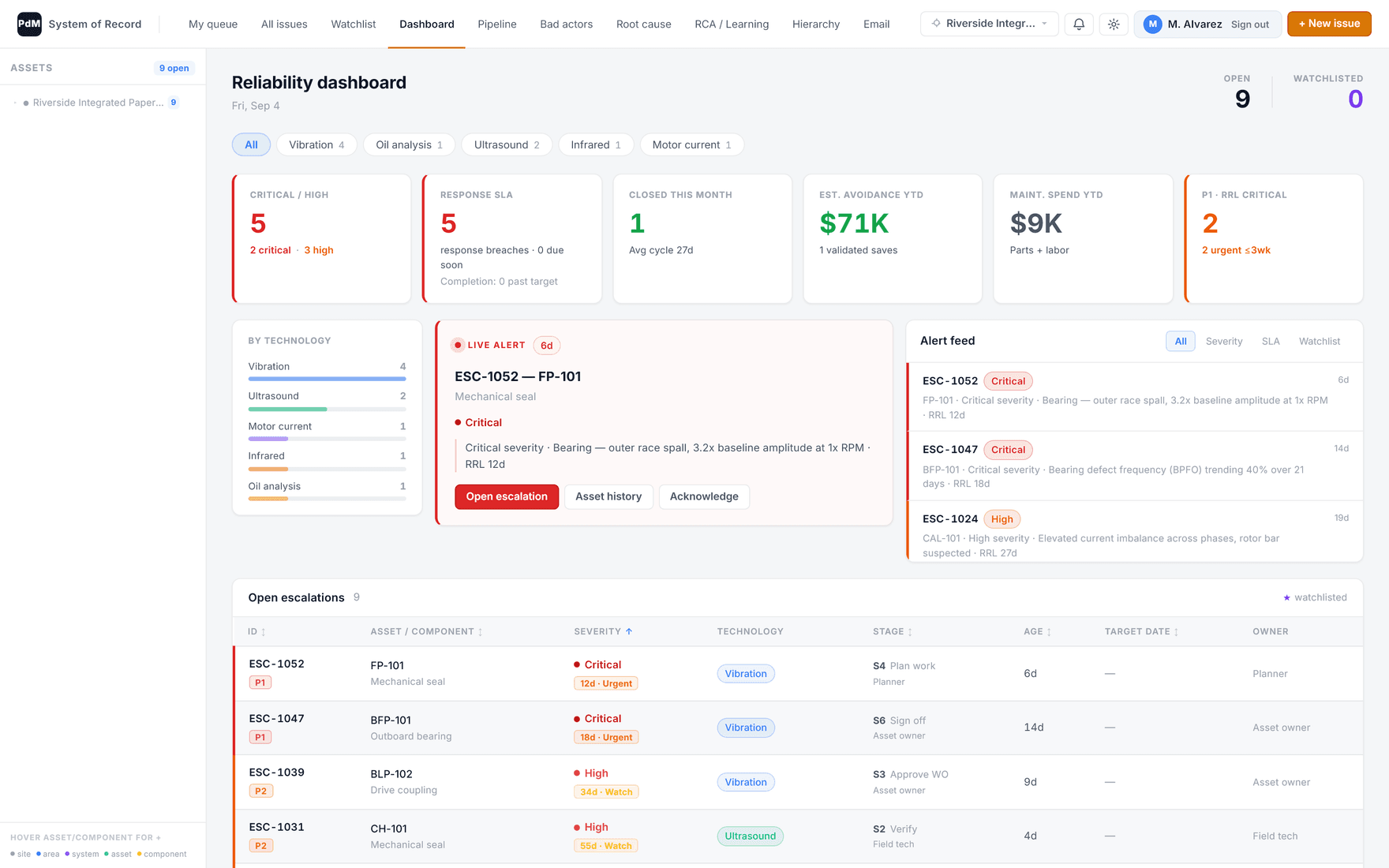
The state of the program, without assembling it by hand.

Open escalations by severity and technology, response times, work closed this period, and the cost recorded against it. Because each figure is drawn from the escalations themselves, the program's position can be shown at any time rather than reconstructed before a review.

The reliability dashboard: counts of critical and high escalations, response times, work closed this month, recorded cost, a live alert and a table of open escalations.
Fig. 05Program status, drawn from the escalation record.

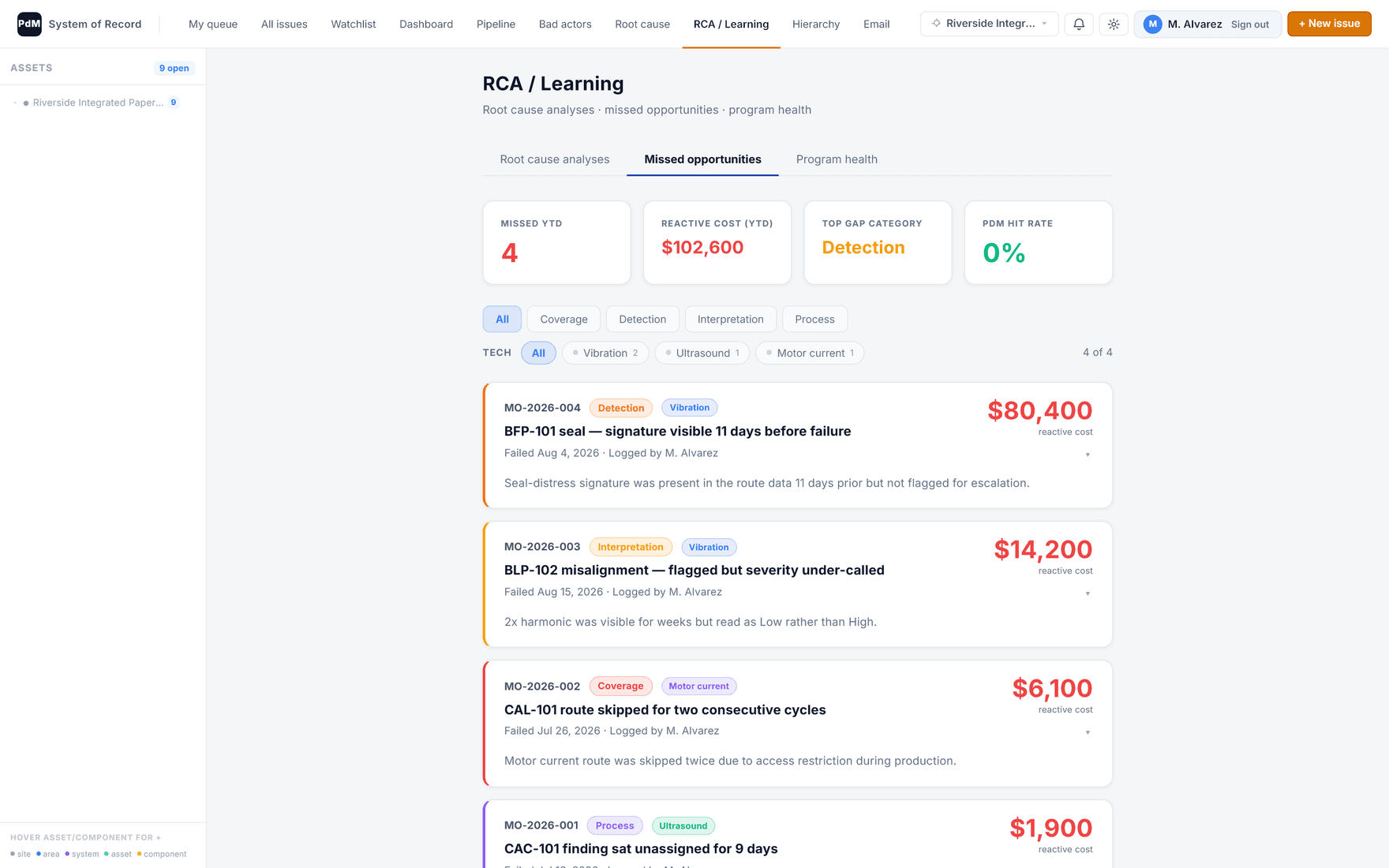
What the program missed, recorded as carefully as what it caught.

A fault that was detectable and went uncaught is logged by category — detection, interpretation, coverage or process — alongside the reactive cost it carried. Kept honestly, it is the record that tells you where to place the next route, the next threshold, or the next analyst's attention.

The missed escalations view: totals for missed faults and reactive cost, the leading gap category, and a list of missed faults each tagged by category with its cost.
Fig. 06Missed escalations, categorized by the gap that let them through.

What each escalation carries

The reliability record most programs keep across a dozen spreadsheets, held in one place and attached to the equipment it concerns.

Asset and componentTied to your hierarchy, with the asset's criticality rating.
Severity and remaining reliable lifeThe analyst's determination, and the time it affords you.
The stage it occupiesWhich of the eight stages, and how long it has been there.
Production impact and maintenance costRecorded at approval rather than estimated afterwards.
Baseline and validation measurementsThe readings before and after that establish the repair held.
Root cause analysis and evidenceFive whys, physical and latent causes, corrective actions, attached files.
Bad actors and repeat offendersAssembled from the escalation history rather than from memory.
Missed escalationsFaults that were detectable and not caught, logged by category with what they cost.

Escalations from vibration, oil analysis, ultrasound, infrared and motor current all follow the same process.

See it on your own equipment.

A thirty-minute walkthrough of the process, end to end: an escalation on one of your asset classes, from the analyst's call to the validated close.

Sign in with Microsoft Entra ID or email. Roles for analysts, technicians, planners and asset owners.

Bring your asset hierarchy in from a spreadsheet. Export program reports as PDF or CSV.