Work management for condition monitoring.
Datum carries every escalation through eight stages, from the analyst's call to the post-repair reading, and counts it as a save only when that reading shows the repair worked. Your CMMS still executes the work. Datum holds the condition evidence, the decisions and the proof.
What Datum holds.
The reliability record often kept in spreadsheets and email, in one place and attached to the equipment it concerns.
Escalations from vibration, oil analysis, ultrasound, infrared and motor current all follow the same process.
Follow one escalation through Datum.
A drive-end bearing on a boiler feed pump, from the analyst's call to the validated close. Then the program it feeds, and how a site is set up.
Prefer to watch? See the films: two minutes for your role, then the chapters.
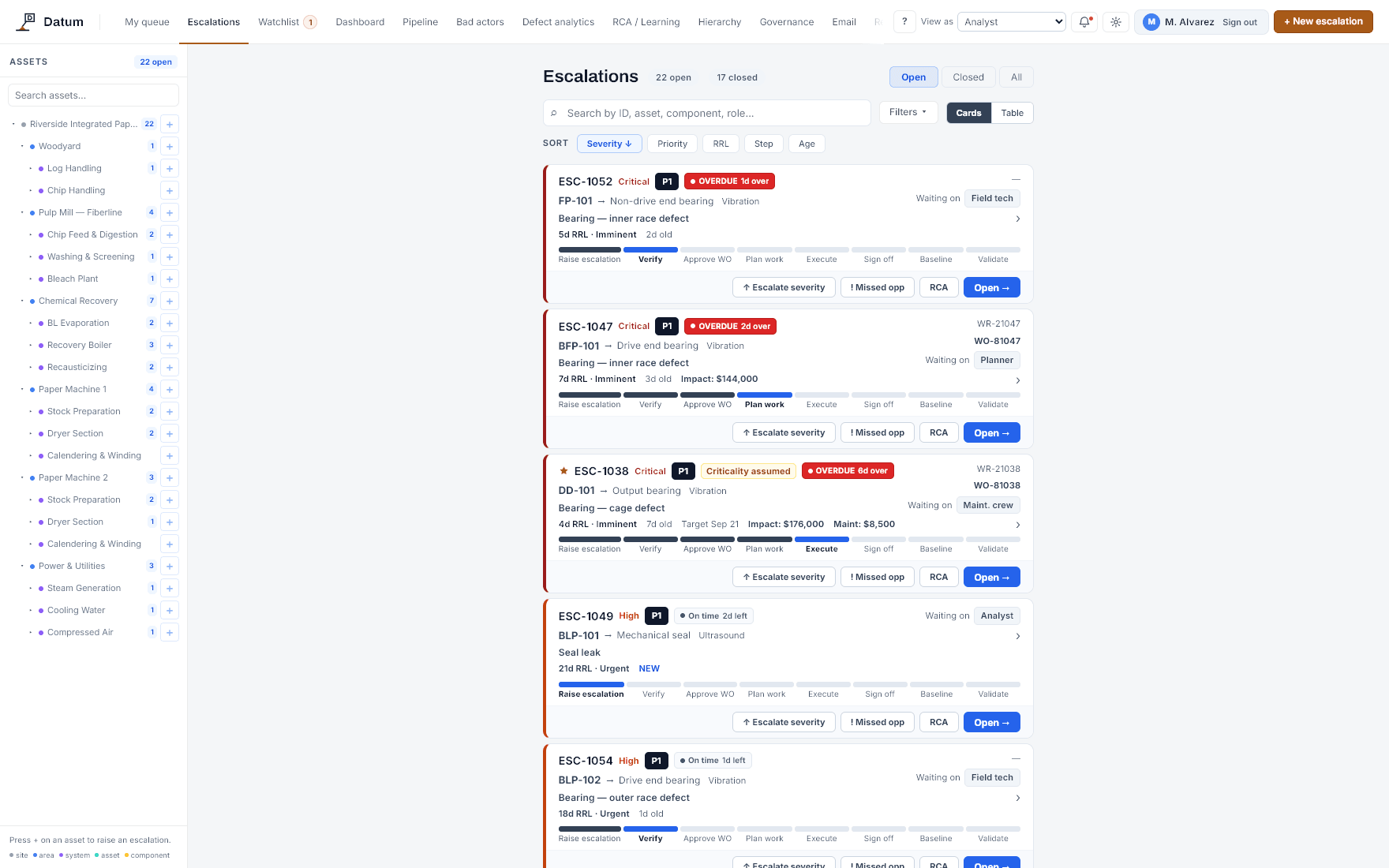
Ordered by consequence, not arrival.
Every open escalation, ranked by the asset's criticality, the severity of the fault, the remaining reliable life and the production impact on record. Each card shows the stage it occupies and the role it is waiting on; one with no remaining reliable life recorded says so, and is ranked as if it were imminent.
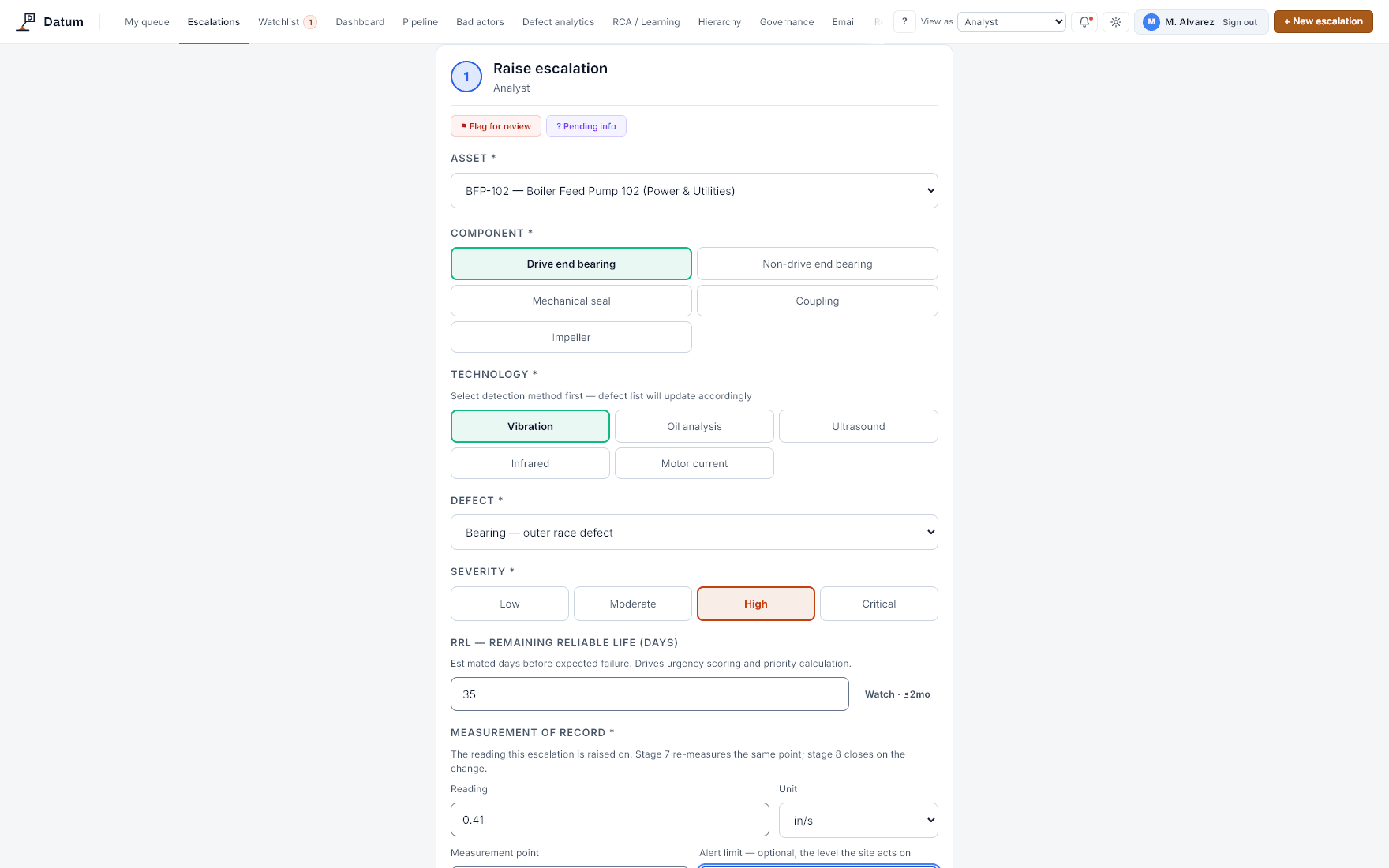
The analyst's call.
On boiler feed pump BFP-102, the analyst records a drive-end bearing defect: outer race, High severity, 35 days of remaining reliable life, replace at the next outage. The reasoning behind the call is recorded with it, and so is the reading it is raised on — 0.41 in/s at the drive-end bearing, against a 0.30 alert limit. The spectrum behind it attaches here.
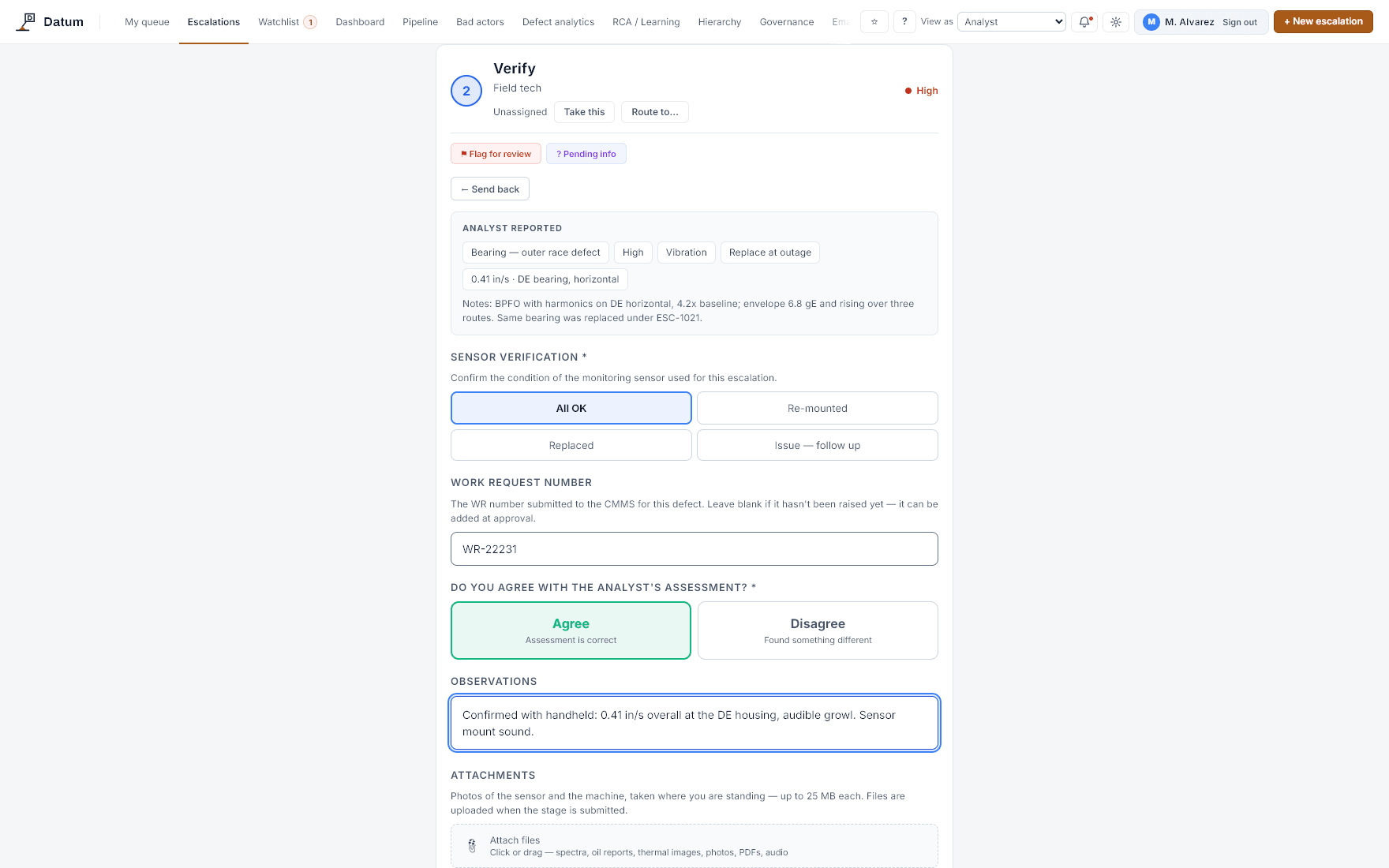
Verified at the equipment.
A technician at the site confirms the sensor, the machine and the symptom, and attaches the work request raised in the CMMS. A misidentified asset is caught here, before anything is planned.
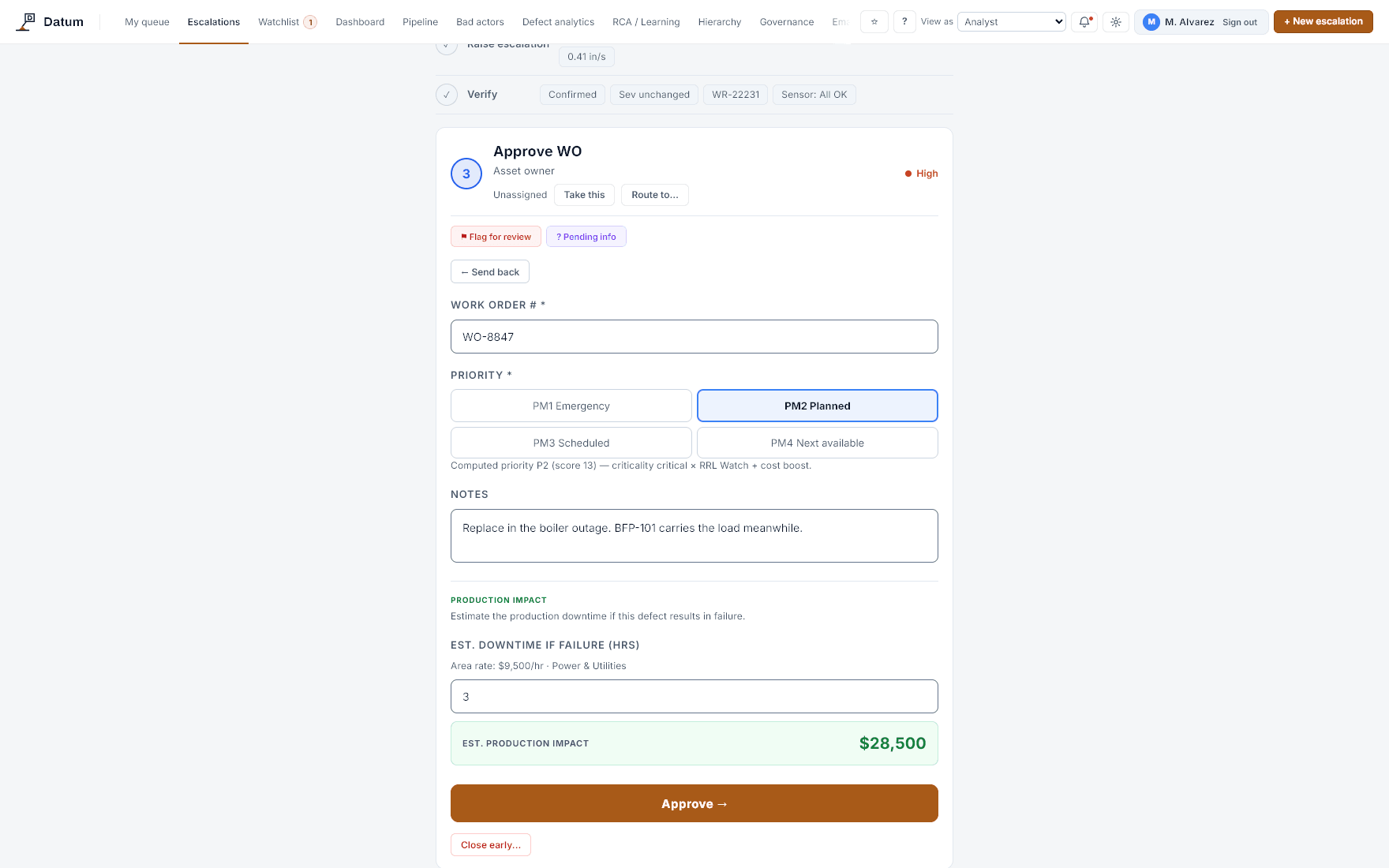
Approved, with the cost of waiting.
The asset owner authorizes the work order and records what a failure would cost: three hours of downtime, priced at the area's production rate at the moment the decision is made.
An escalation is a record, not a ticket.
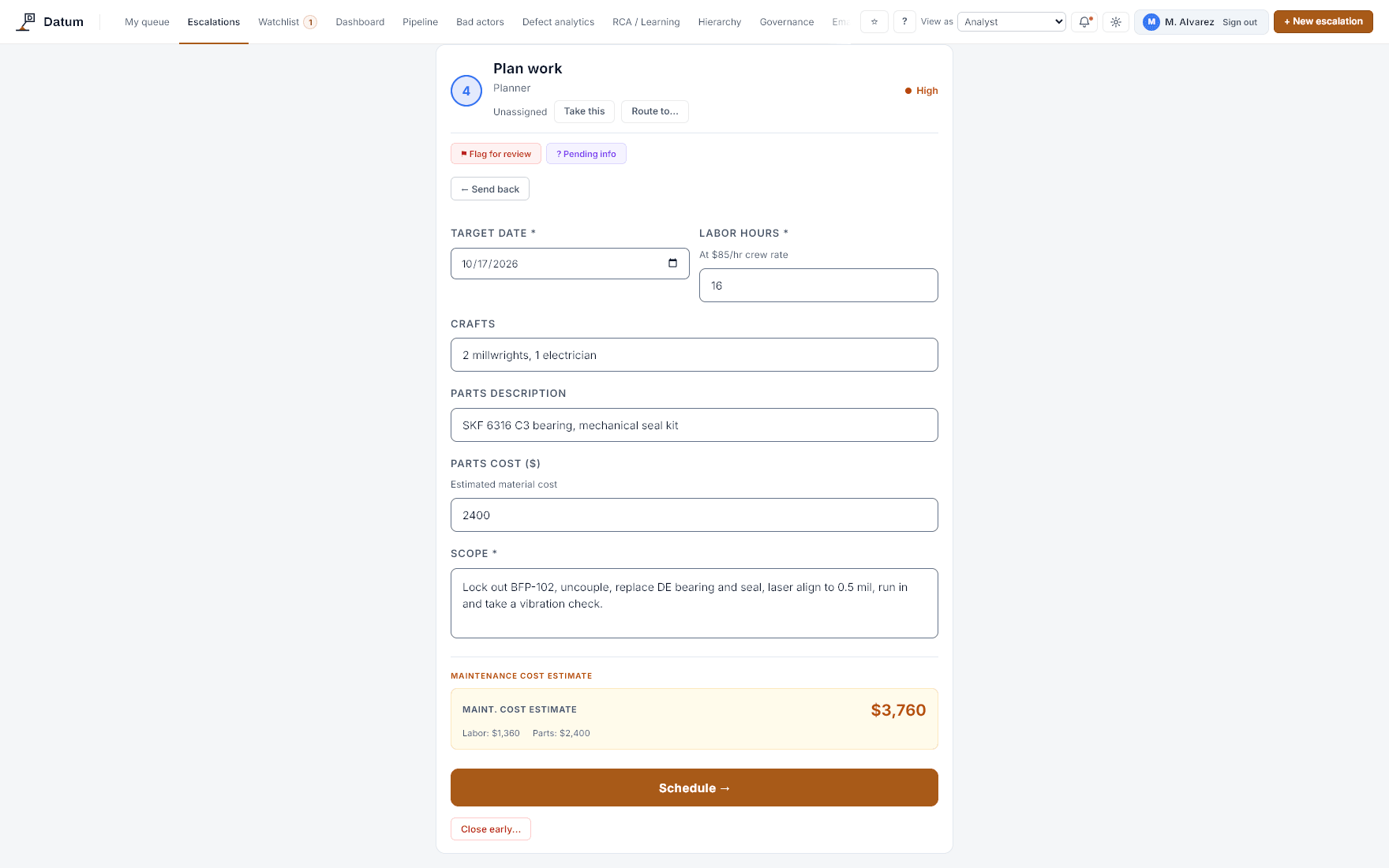
Planned into the boiler outage with labor, crafts, parts and scope. The original call, the verification and the approved impact stay attached, and a search on the work order number brings it up.
Watchlisted until the outage.
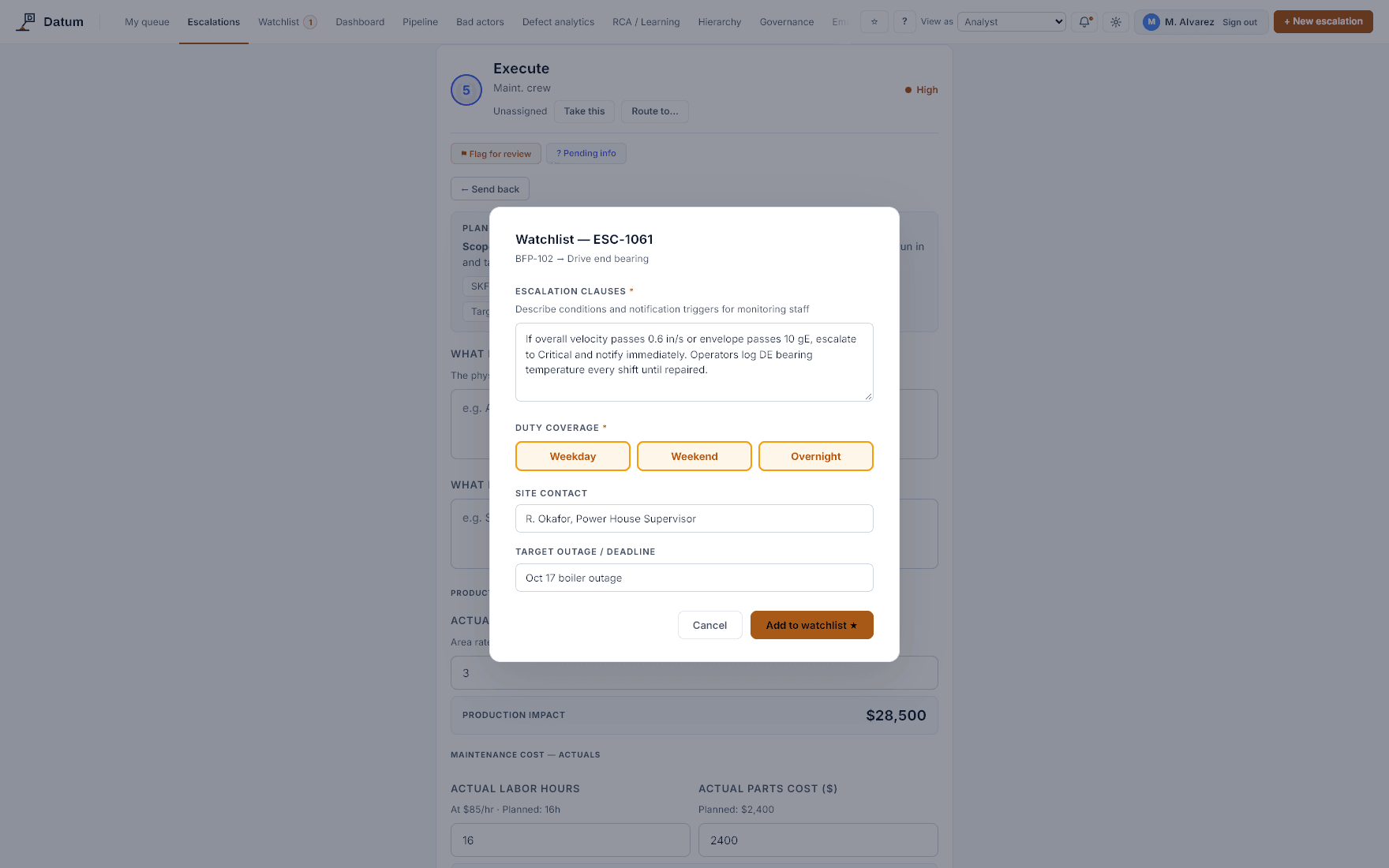
While it waits, the escalation carries its instructions, duty coverage and site contact. If it worsens, what to do is already written down.
What the crew found.
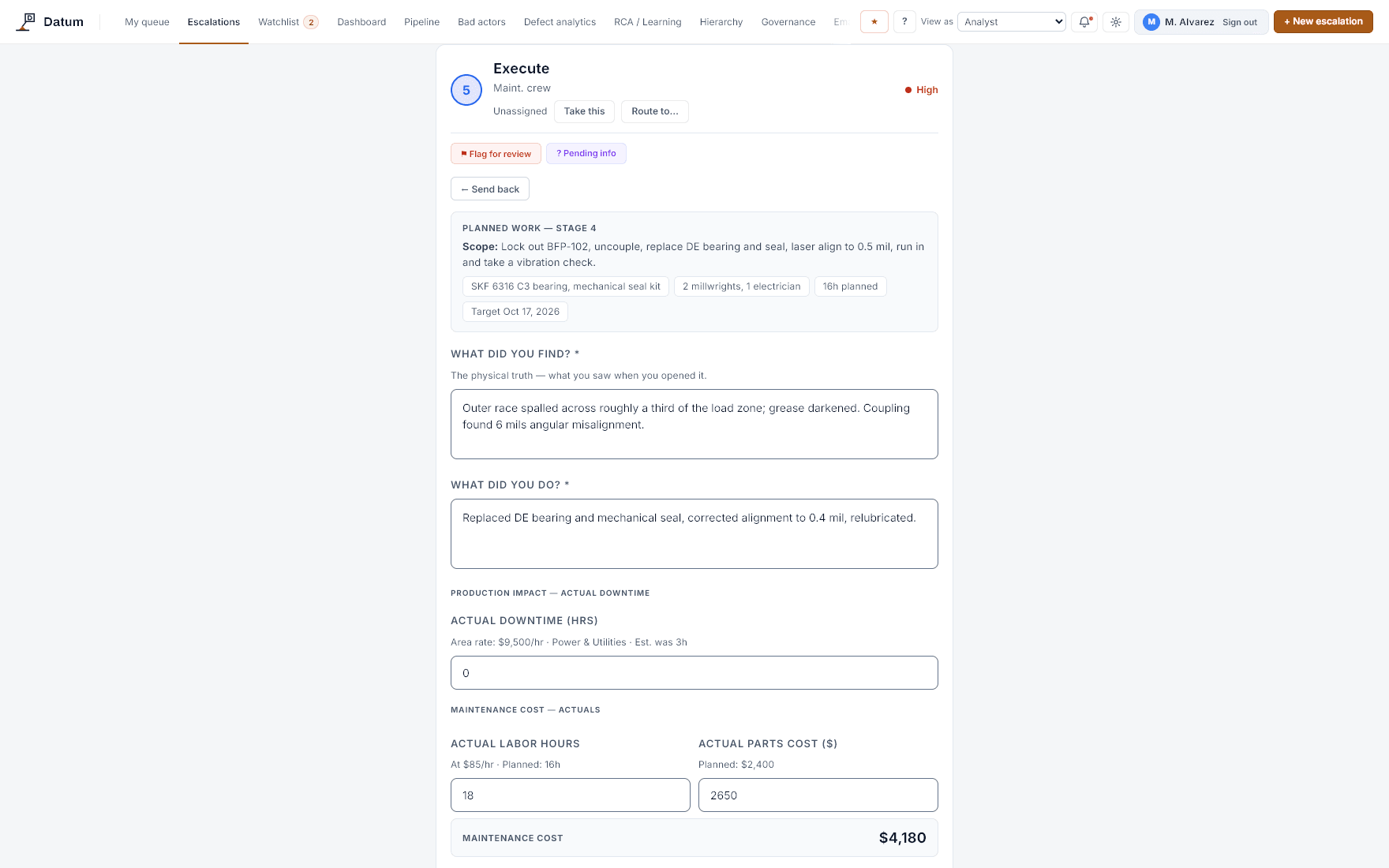
Executed in the outage. The crew sees the plan it is executing and records what they found on opening it — a spalled outer race and six mils of misalignment — what they did about it, and the actual downtime, labor and parts the repair took.
Signed off, then rechecked.
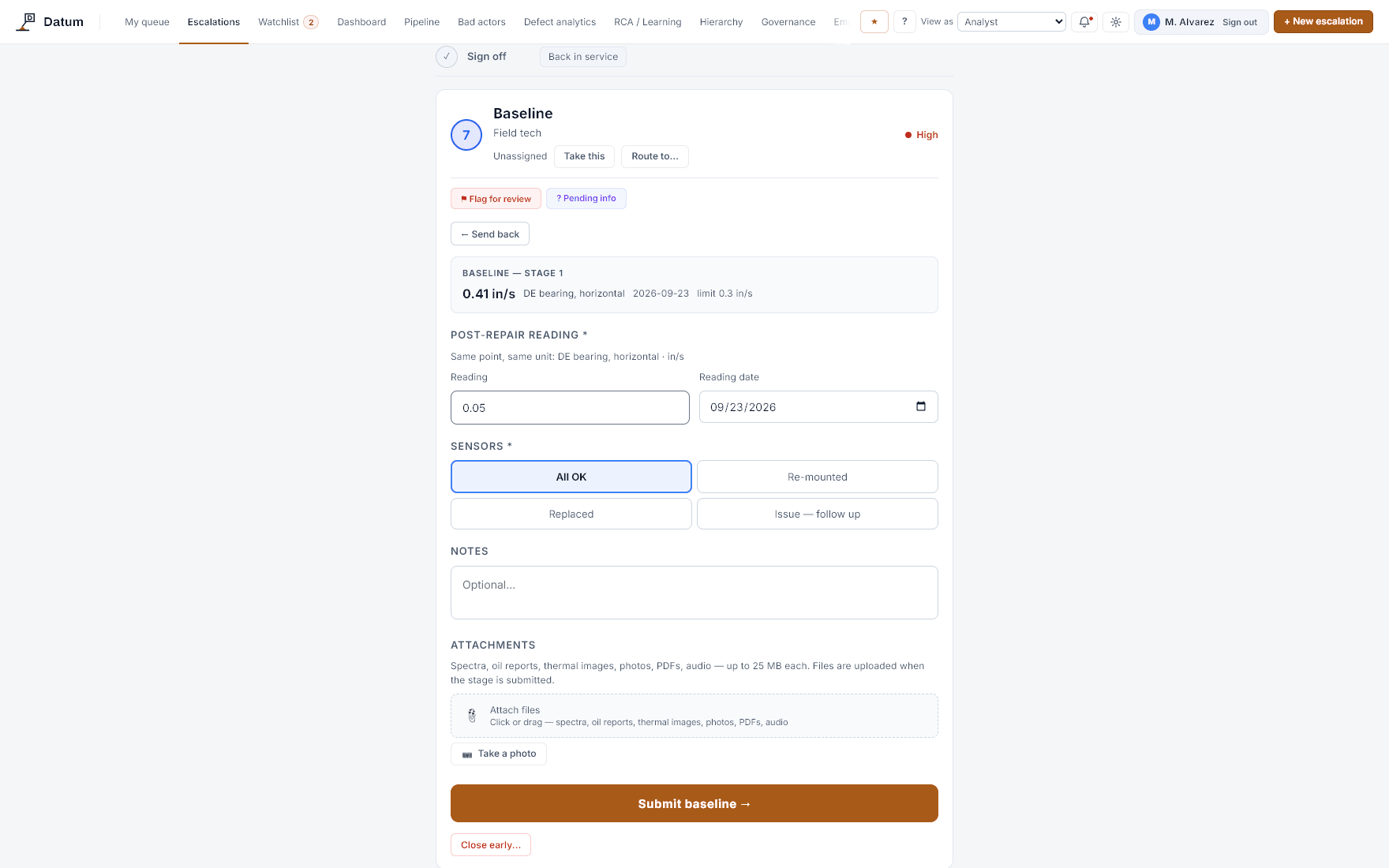
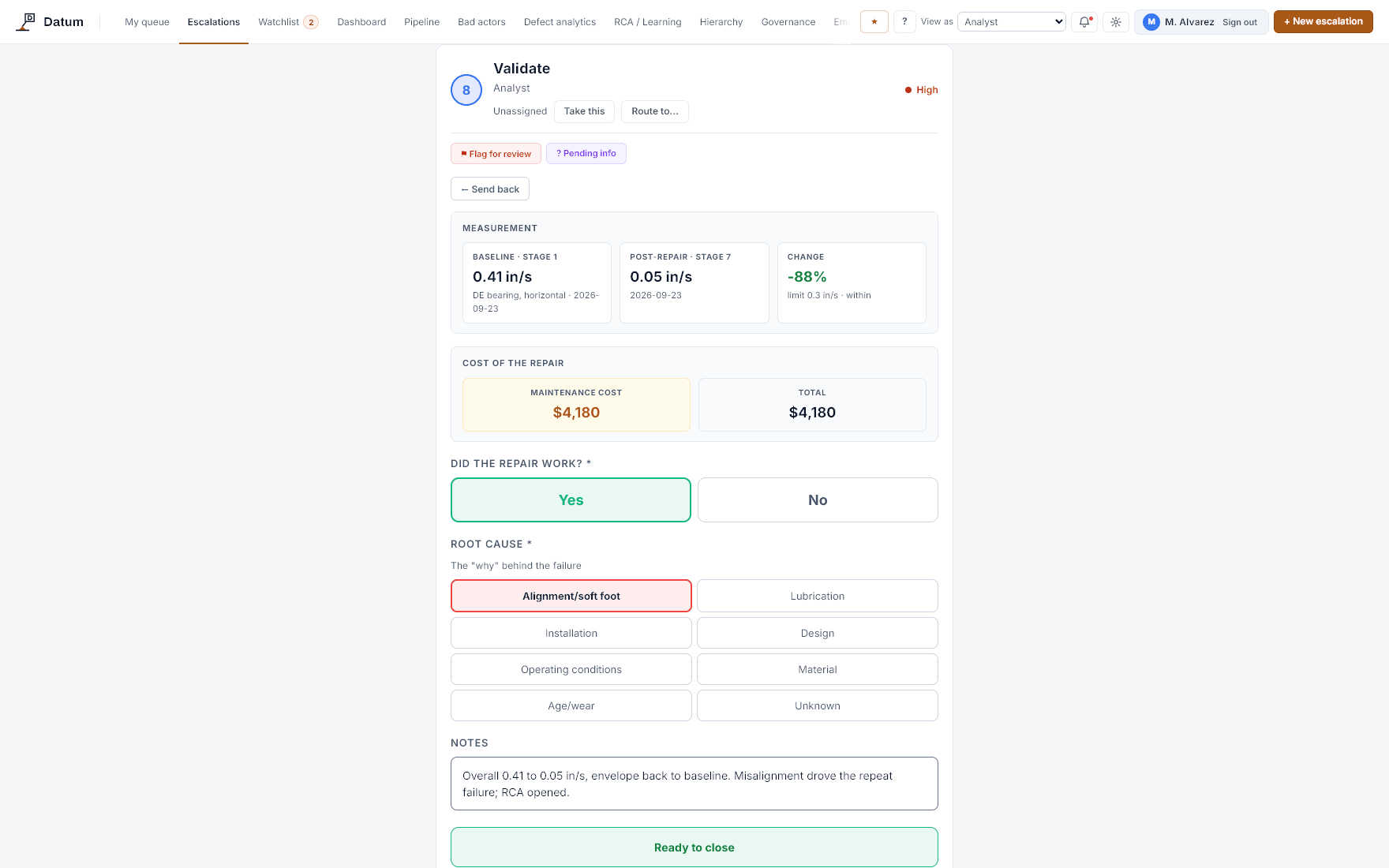
Sign-off confirms the machine is back in service. That closes the work, not the escalation: the technician then rechecks the same point, 0.41 in/s when it was raised and 0.05 now.
No post-repair reading, no save.
The analyst sees the change against the first reading — 0.41 to 0.05 in/s, 88% lower — then confirms the repair worked and records the root cause. A reading that rose and stays over the limit can't be a save; it goes back for a recheck.
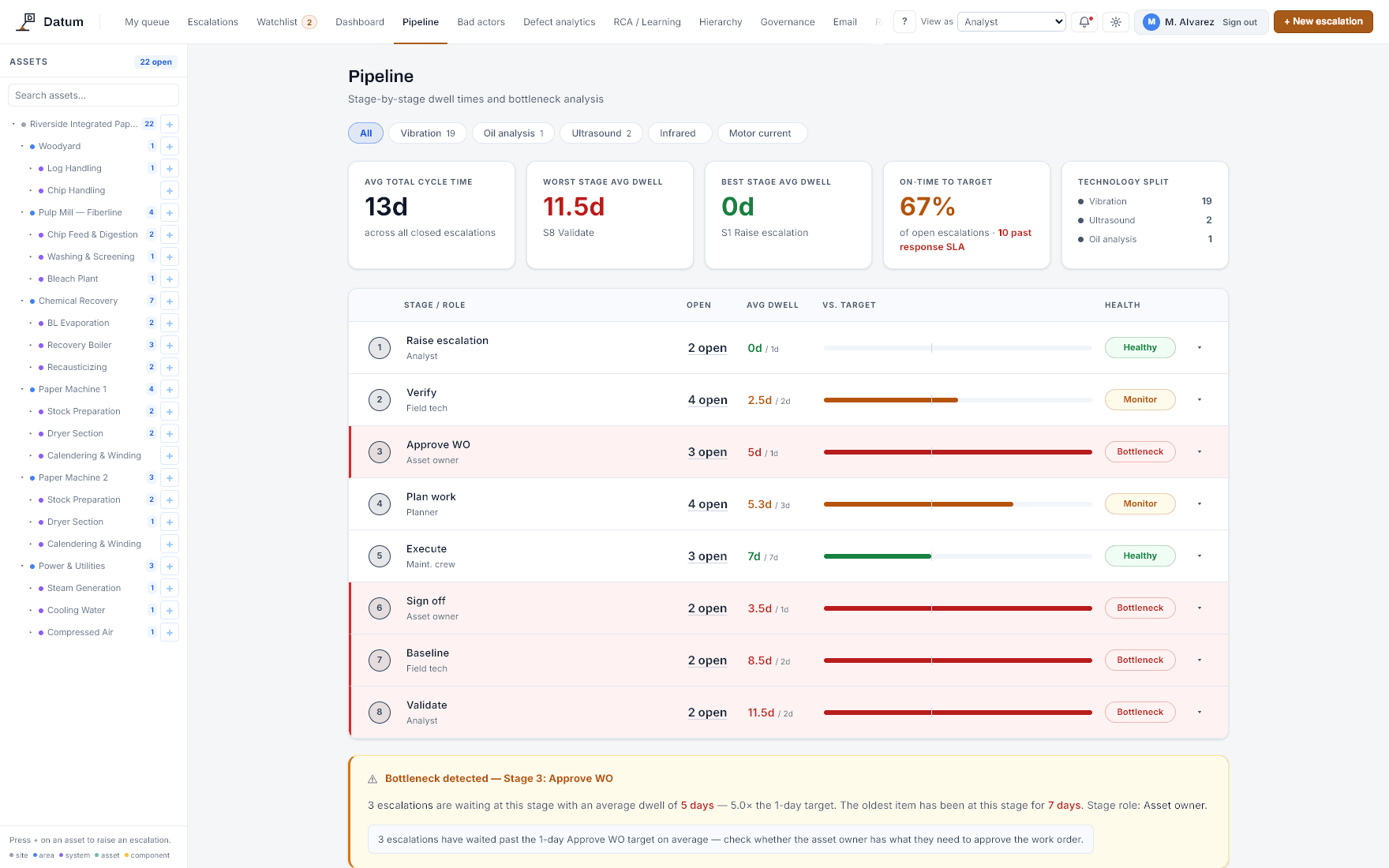
Stage by stage.
How many open escalations sit at each stage and how long since they were raised, with the on-time rate and total cycle time.
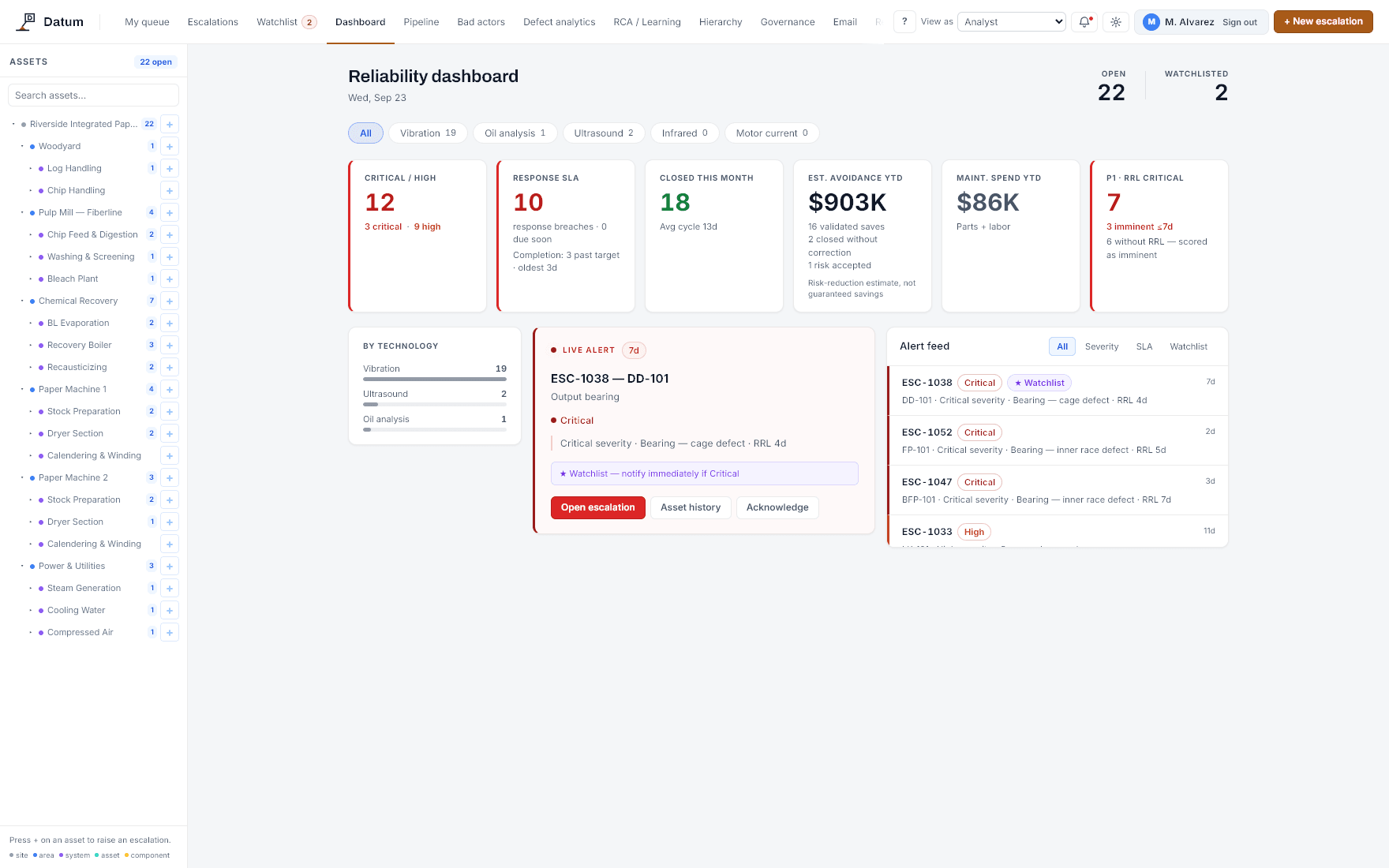
The state of the program, without assembling it by hand.
Open escalations by severity and technology, response against target, closed work and the cost recorded against it. Every figure is drawn from the escalations themselves: a save is a validated close, an accepted risk is counted as what it is, and an escalation with no remaining reliable life on record is scored as imminent.
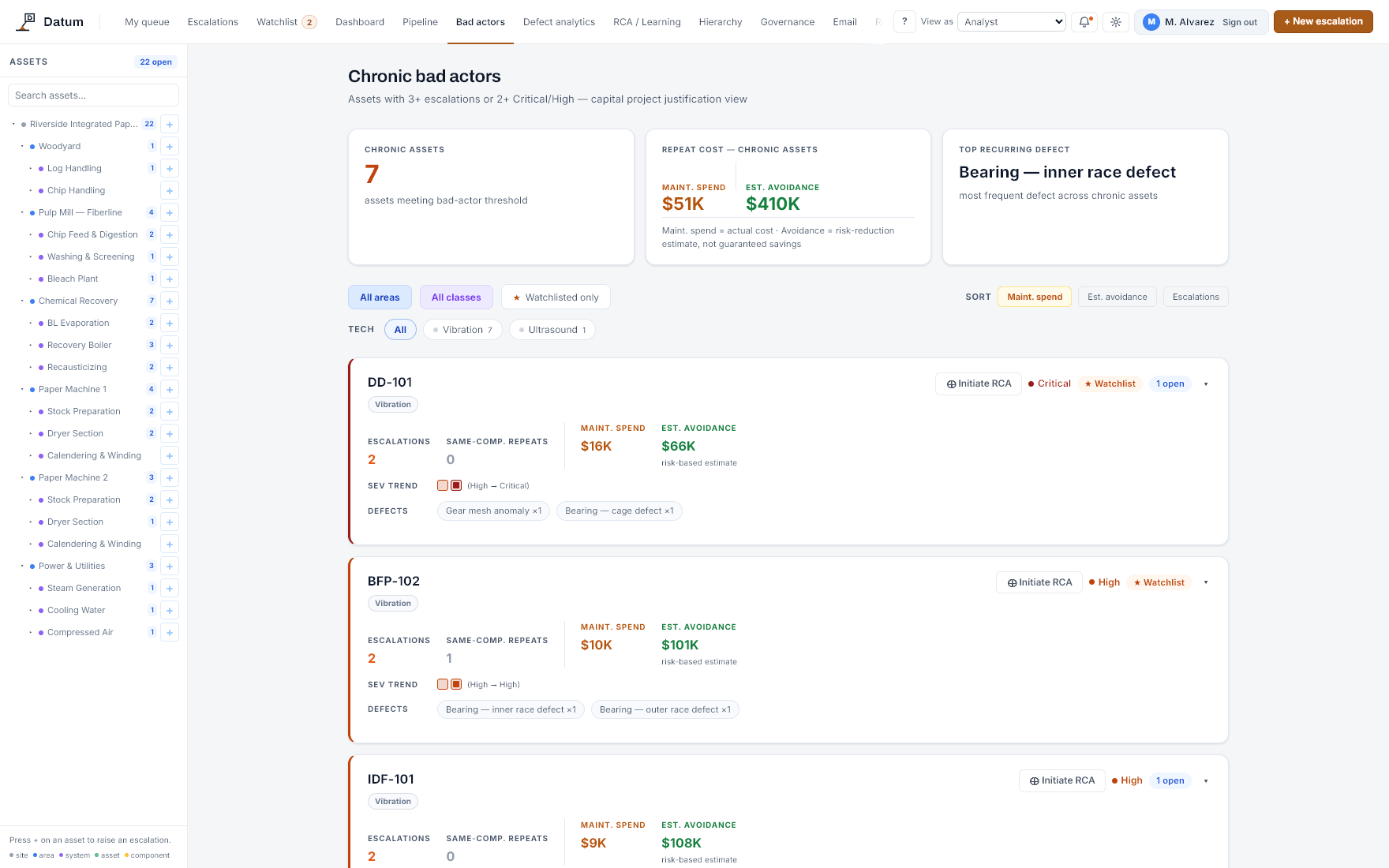
The same machine, again.
Chronic assets surface from the escalation history on their own: how often each has returned, its severity trend, its recurring defects and what it has cost.
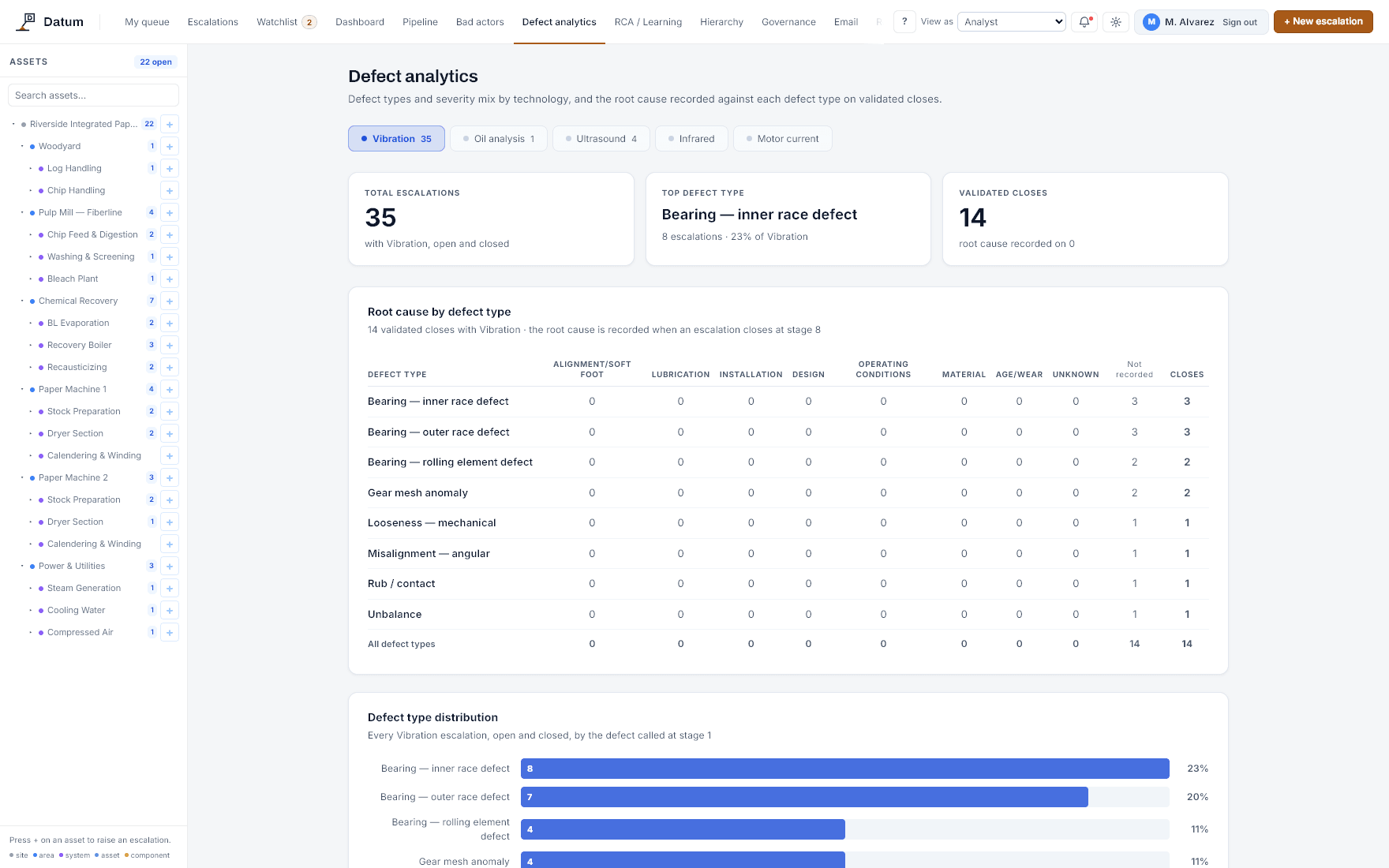
Patterns across every escalation.
Defect types and severity mix by technology, and for every validated close, the root cause recorded against the defect it presented as. Each figure is a count from the record, not an inference.
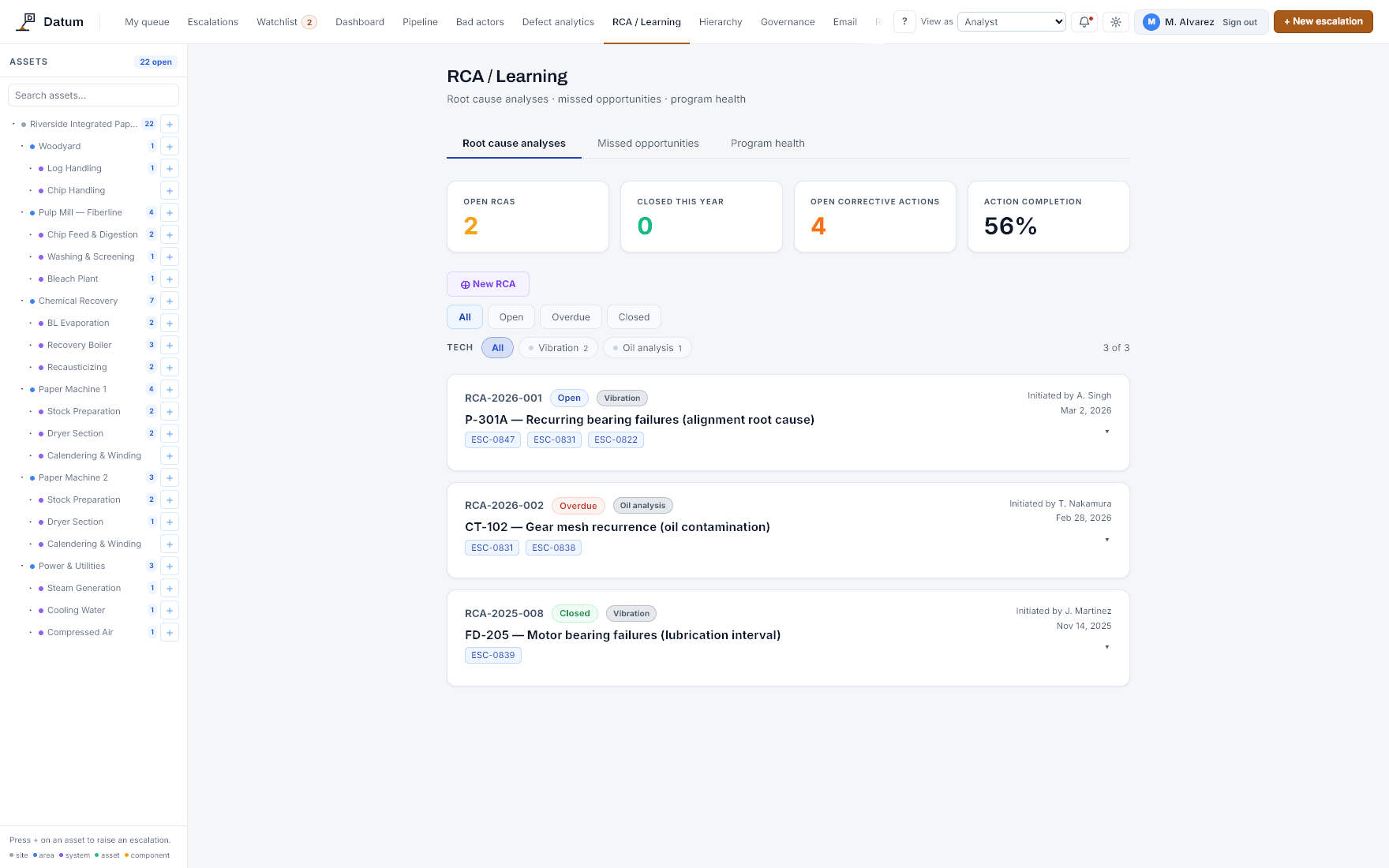
Root cause analysis, kept with the escalations it came from.
Five whys, physical and latent causes, corrective actions and evidence, each linked to the escalations that prompted the investigation.
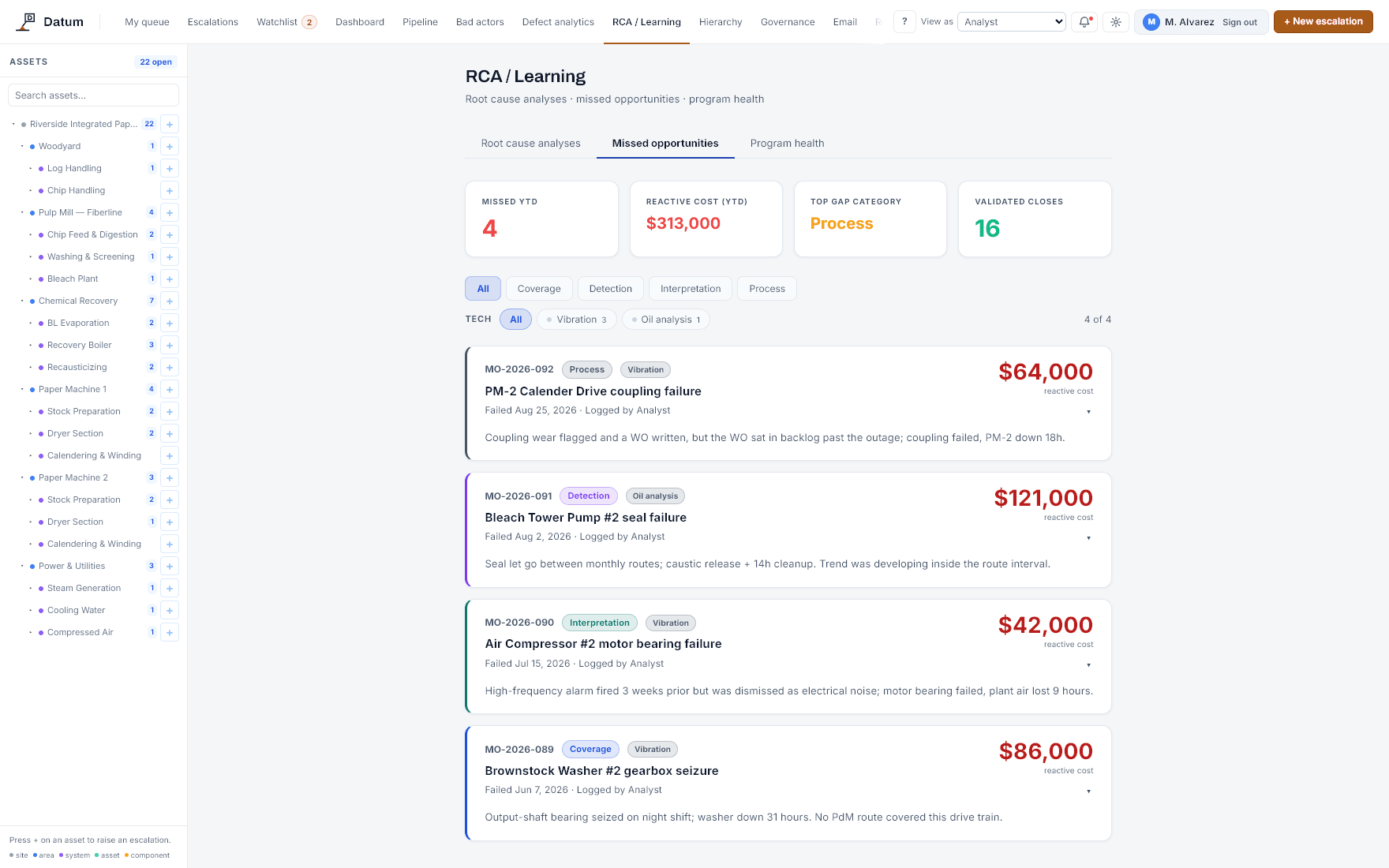
What the program missed, recorded as carefully as what it caught.
A fault that was detectable and went uncaught is logged by category — detection, interpretation, coverage or process — with the reactive cost it carried.
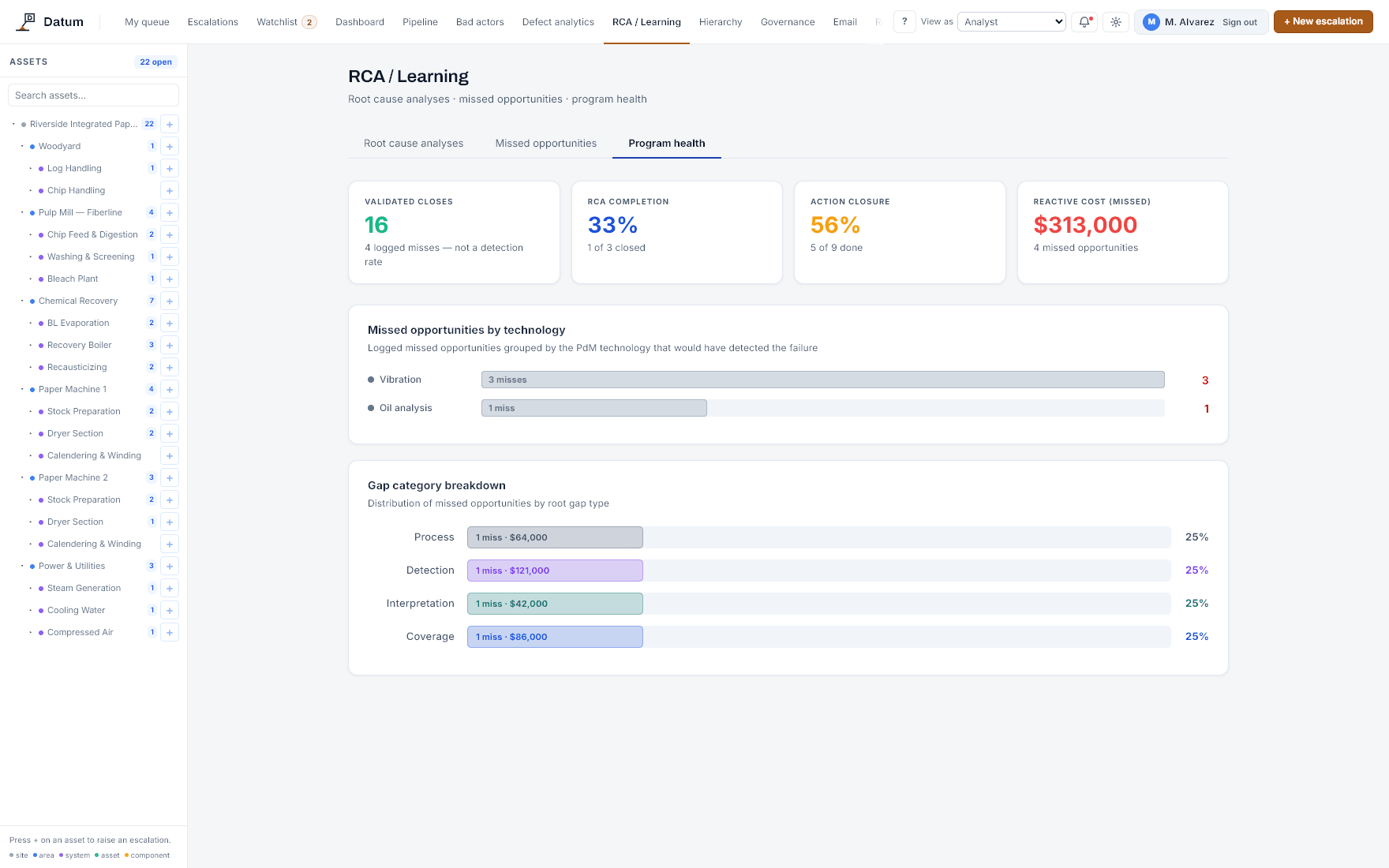
The program's own scorecard.
Validated closes beside logged misses, RCA completion and action closure, with misses by technology and the gap that let them through.
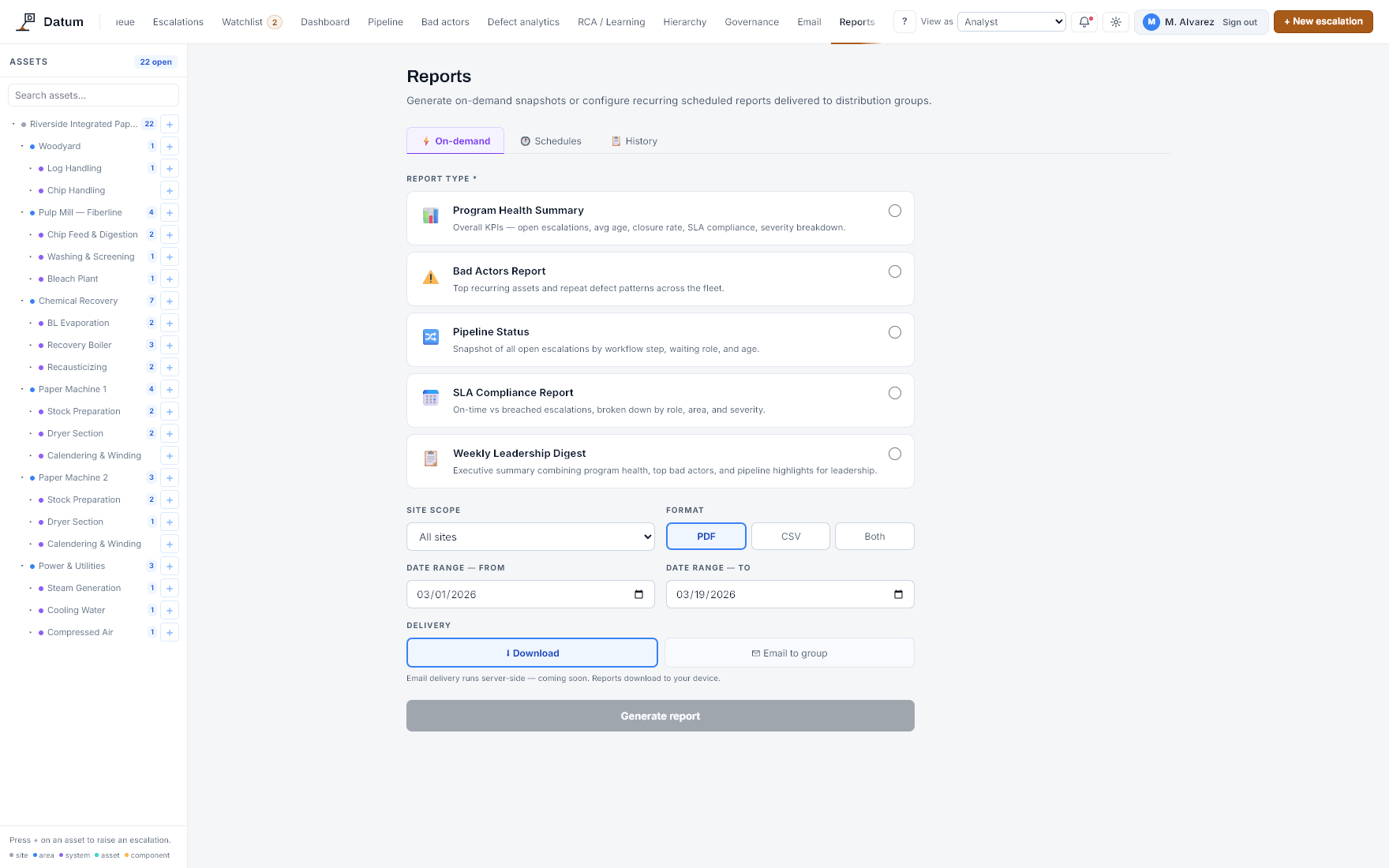
Reports when you need them.
Program reports as PDF or CSV, generated on demand from the same record the site works from.
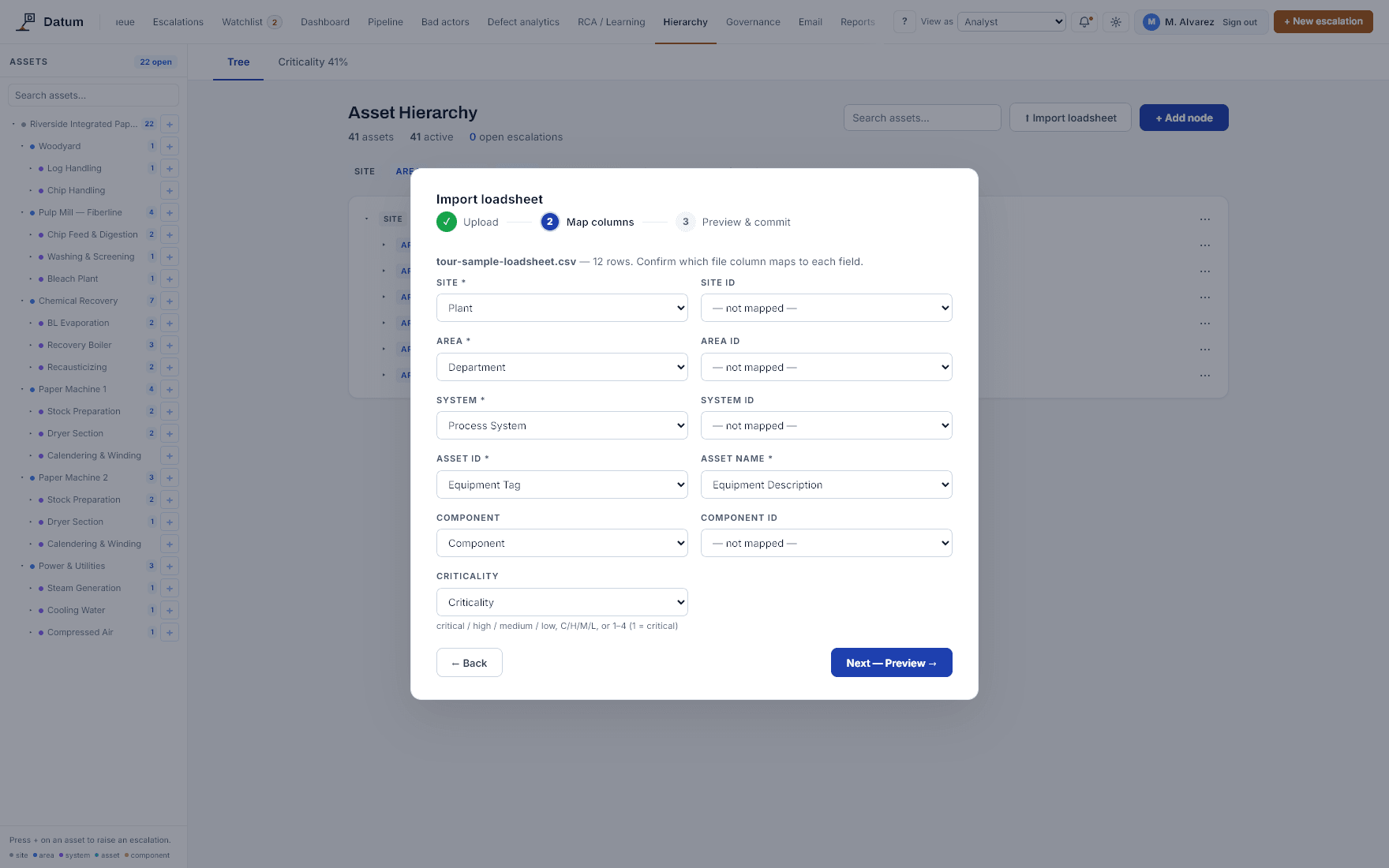
Your hierarchy, from a CSV.
Upload a CSV loadsheet and map its column names — whatever your plant calls them — to site, area, system, asset, component and, if your sheet carries one, criticality. Nothing is written until you have previewed what will change.
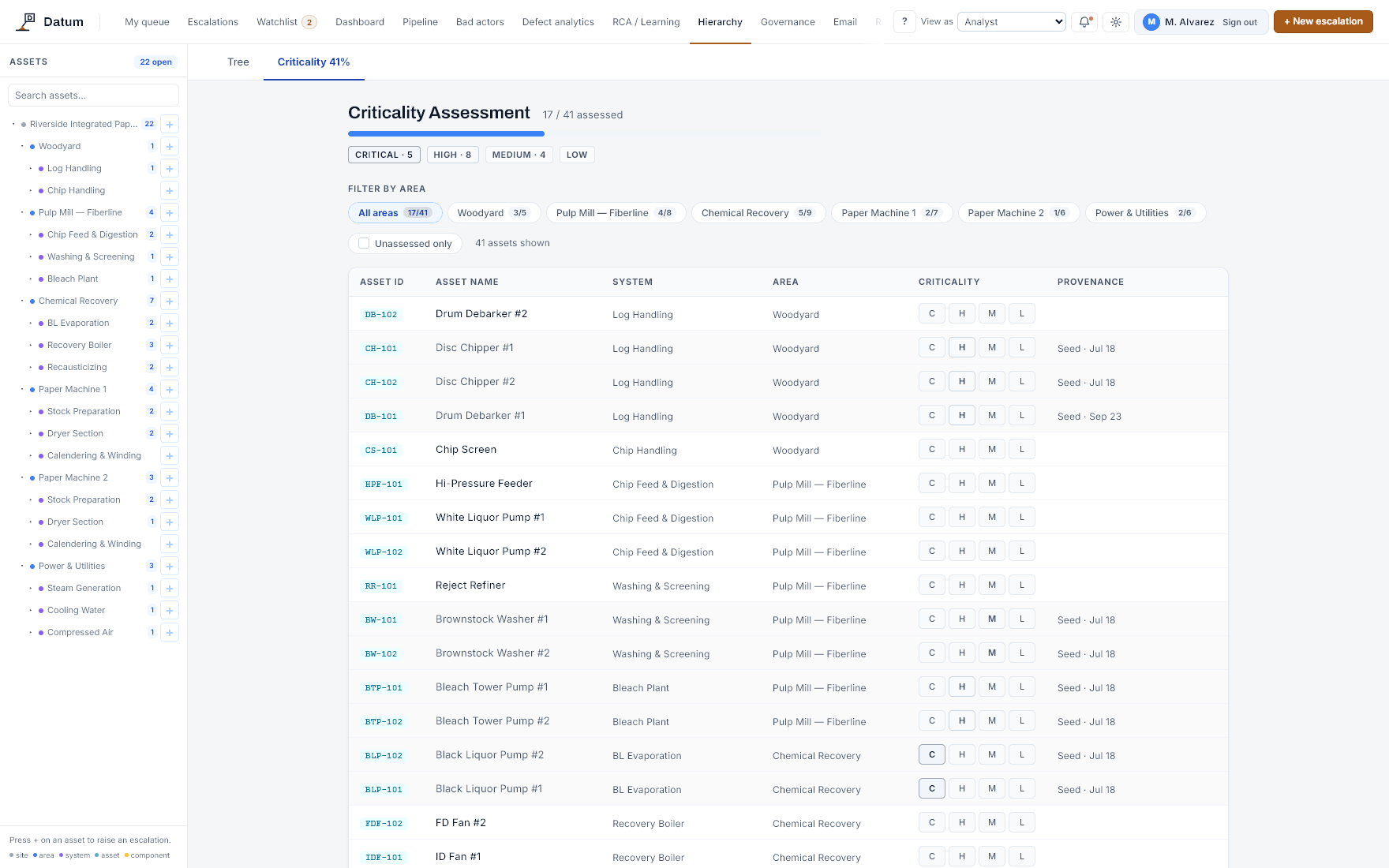
Consequence sets the order, not arrival time.
Each asset is scored once against four criteria — safety, production, repair cost and lead time, redundancy — and the tier that follows feeds the queue's ranking from then on, beside severity and remaining life, with who assessed it and when on record.
Screenshots show Datum's demonstration facility, an integrated paper mill. Select an image to open it full size.
Detection is rarely the problem. What follows it is.
A capable analyst identifies a developing fault and issues a report. It reaches the site as an attachment. From there the escalation depends on recollection: someone has to read it, judge it, raise the work, schedule it, and afterwards confirm the condition actually improved.
Each of those hand-offs happens outside any system that records them, and any one of them can quietly end the matter. Programs seldom fail because the analysis was wrong. They fail because a sound call was made and nothing durable was built around it.
The report goes out, and nothing comes back.
An escalation moves through eight defined stages and always occupies a known one. What was raised, what was decided and what remains outstanding is visible without anyone being asked.
The work order was closed. Whether the fault is gone is a separate question.
No save is counted without a follow-up reading taken against the baseline. Completion and correction are recorded as the different claims they are.
Everything is urgent, so work happens in the order it arrived.
Order is set by the asset's criticality rating, the severity of the escalation and its remaining reliable life — not by who raised the matter most recently.
“We’ll pick it up at the next outage,” and then nobody does.
A deferral carries a review date and returns to the queue when that date arrives. A hold left open indefinitely ages and is flagged rather than forgotten.
The same machine keeps failing and no one has joined the incidents up.
Repeat offenders are assembled from the escalation history itself, so the pattern is visible from the record rather than from whoever happens to remember it.
The one that was missed is never examined.
Faults that were detectable and not caught are logged against the program by category — detection, interpretation, coverage or process — with the reactive cost they carried.
Eight stages, and an escalation always occupies one of them.
An escalation enters as the analyst's call and leaves as a validated repair or a recorded decision. Every stage is defined, and the record always shows which one an escalation sits at. Nothing rests in an undefined state.
Select a stage to see what it involves.
Stage 1 of 8 · Analyst
Raise escalation
The analyst records the determination against the asset and component: technology, defect, severity, and the remaining reliable life the condition affords. Spectra and supporting data attach here, so the reasoning travels with the escalation rather than in an email beside it.
Stage 2 of 8 · Field tech
Verify
Someone at the site confirms the machine, the component and the symptom against what was called. A remote analyst works from data; verification is where the escalation meets the equipment, and a misidentified asset is caught before any work is planned.
Stage 3 of 8 · Asset owner
Approve WO
The asset owner accepts the escalation and authorizes work, recording the production impact and the expected maintenance cost at the moment the decision is made rather than reconstructing them afterward.
Stage 4 of 8 · Planner
Plan work
The planner schedules against the outage calendar and raises the work order in the CMMS. The work order number is recorded here, and from this point it is the join between the two systems.
Stage 5 of 8 · Maintenance crew
Execute
The craft performs the repair and records what was done, including what was found on disassembly. Where that differs from the original call, the difference is part of the record and feeds the analysis later.
Stage 6 of 8 · Asset owner
Sign off
The asset owner confirms the work is complete and the machine is back in service. This closes the work, not the escalation — the two are deliberately separate.
Stage 7 of 8 · Field tech
Baseline
A fresh reading at the same point records the machine's condition after the repair. Without it there is nothing to validate the repair against.
Stage 8 of 8 · Analyst
Validate
The analyst compares the new reading with the first and confirms the repair worked. Only here can it close as a save. If the condition persists it goes back for a recheck instead of closing on a completed work order.
See the eight stages running on your own equipment.
Request a demoDatum does not replace your CMMS.
Your CMMS plans labor, reserves parts and records completion, and it should go on doing so. What it was never designed to hold is the reasoning behind the request: the spectra, the severity judgment, the remaining life estimate, and the measurement that afterwards shows whether the repair worked.
Datum holds that material and references the work order by number, so the two records stay joined without either system pretending to be the other.
Your analysts work wherever they are.
Whether an analyst sits in the building or reviews your routes from three states away, escalations are entered into the same record the site works from. The site can see the reasoning behind a call; the analyst can see what became of it. Neither has to ask.
See it on your own equipment.
A thirty-minute walkthrough of the process, end to end: an escalation on one of your asset classes, from the analyst's call to the validated close.
Sign in with Microsoft Entra ID or email. Roles for analysts, technicians, planners and asset owners.
Bring your asset hierarchy in from a CSV. Export program reports as PDF or CSV.